



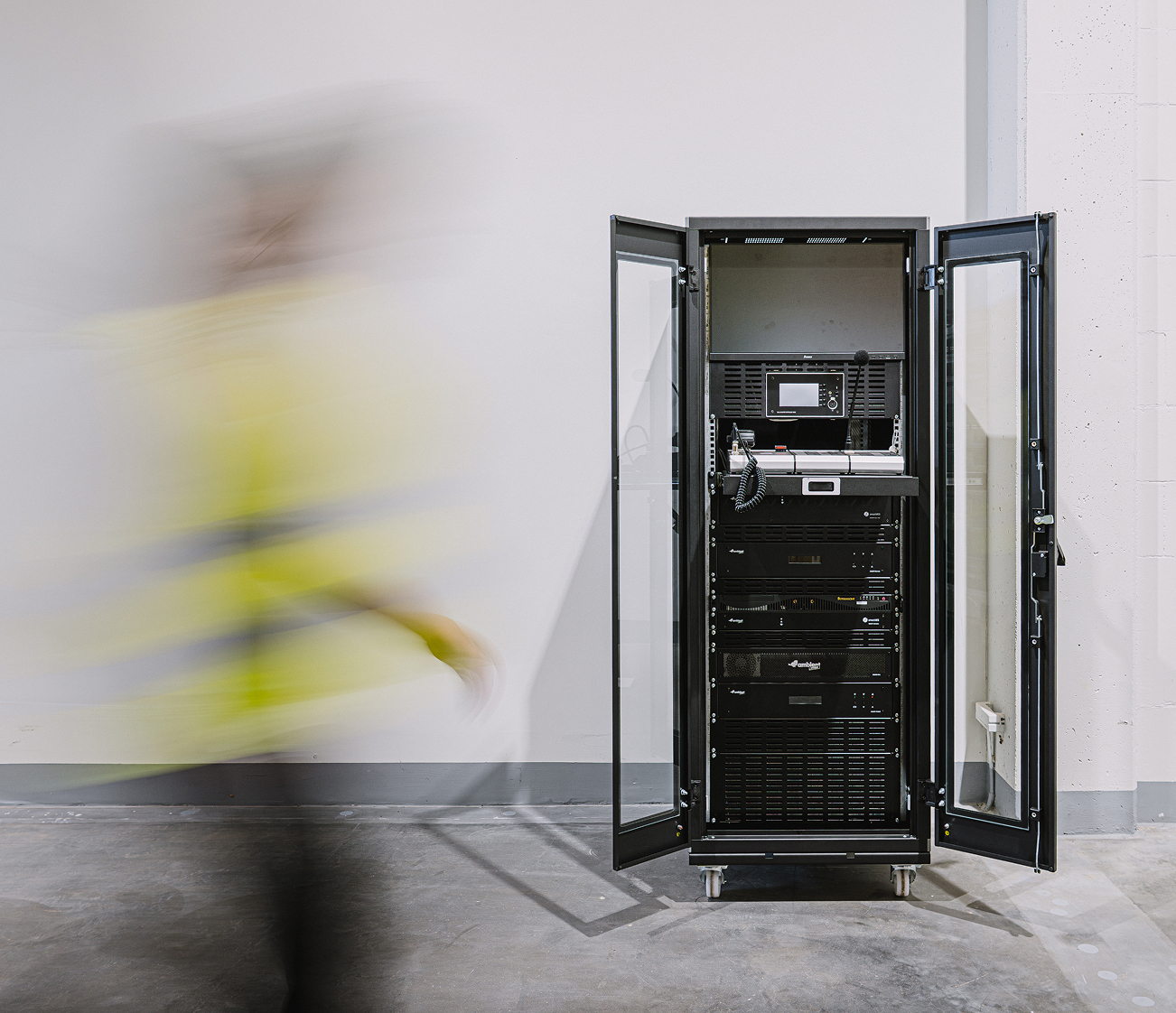
As users, we rarely notice this hidden infrastructure. Cables disappear into walls, devices blend into the architecture, loudspeakers become part of ceilings and technical spaces remain entirely out of sight. Individually, these elements seem unremarkable. Taken together, they form the foundation that allows a building to function safely and reliably every day.
This becomes particularly evident in large and demanding environments, such as transportation hubs, multi-level shopping centres, office buildings, schools or hospitals. These are spaces designed to handle complexity, movement and risk — yet their safety depends on systems that remain almost entirely invisible.
If we imagine such a building operating without them — without integrated communication, coordinated response or structured evacuation — the gap becomes immediately clear. Safety would no longer be predictable or controllable.
This is precisely where a voice alarm system plays its role: as an invisible layer of protection that becomes decisive the moment conditions change.
What is a voice alarm system?
From a system design perspective, this means that one platform supports daily communication, emergency messaging and coordinated evacuation scenarios. For designers, consultants and system integrators, such an approach simplifies architecture while ensuring compliance with safety standards and operational reliability.
Voice evacuation systems in modern buildings
In large and complex environments, evacuation cannot rely on instinct alone. It requires coordination, clarity and timing. A voice evacuation system enables this by transforming evacuation from a reactive process into a controlled and managed scenario.
Rather than triggering a full evacuation immediately, buildings can implement phased strategies, guiding occupants in stages and adapting communication to specific zones or conditions. This reduces congestion and improves safety by aligning communication with real-time developments.
The effectiveness of this approach is closely linked to how people respond to information. Voice messages provide context, reduce ambiguity and support decision-making under pressure. Instead of uncertainty, occupants receive clear guidance about what is happening and what they should do next.
Voice alarm system components
A voice alarm system is not simply an audio installation extended for emergency use. It is a fully supervised, engineered system designed to operate reliably under critical conditions, with clearly defined performance requirements.
At its core is the voice alarm control and indicating equipment, compliant with EN 54-16, which manages system operation, message routing and monitoring. This ensures that emergency communication is prioritised and delivered without interruption.
Equally important are voice alarm loudspeakers, designed in accordance with EN 54-24, where the focus is on speech intelligibility rather than volume alone. Messages must remain understandable regardless of background noise or acoustic conditions.
Beyond individual components, the system relies on continuous monitoring and redundancy. Every critical path is supervised, faults are detected early, and backup mechanisms ensure uninterrupted operation. This level of reliability clearly distinguishes PAVA systems from conventional audio installations.
From public address to critical communication
The evolution of public address systems into public address and voice alarm systems (PAVA) reflects a broader change in building design. Communication is no longer treated as a separate function but as an integral part of safety infrastructure.
By combining everyday communication with emergency capability, modern systems create a unified platform that supports both operational efficiency and risk management. This integration allows buildings to respond more effectively to changing conditions while maintaining consistency in communication.
For project stakeholders, including consultants, designers and system integrators, this means fewer independent systems, simpler coordination and better alignment with regulatory requirements.
Why voice alarm systems matter in emergency evacuation
In an emergency, the quality of communication directly influences how people behave. A voice alarm system must therefore ensure that messages are audible, intelligible and actionable.
Achieving this depends not only on equipment, but also on system design, acoustic planning and integration with fire detection systems. When these elements are properly aligned, communication becomes predictable and effective.
Under normal conditions, such systems remain almost invisible. But at the moment they are needed, they become one of the most critical elements of the entire building.
Learn more about voice evacuation/voice alarm systems
A deeper understanding of how voice evacuation systems are designed and implemented in real environments is available here: Voice evacuation systems overview